Benefits of Smart Classrooms in Modern Education
Jun 08, 2026
The marketing version looks like a showroom. Screens on every wall. Students tapping tablets in sync. Reality looks different. A projector showing a beating heart while a Class VII student leans forward and asks "that valve opens every time?" That is the point. Smart classrooms earn their cost when a flat textbook concept suddenly moves.
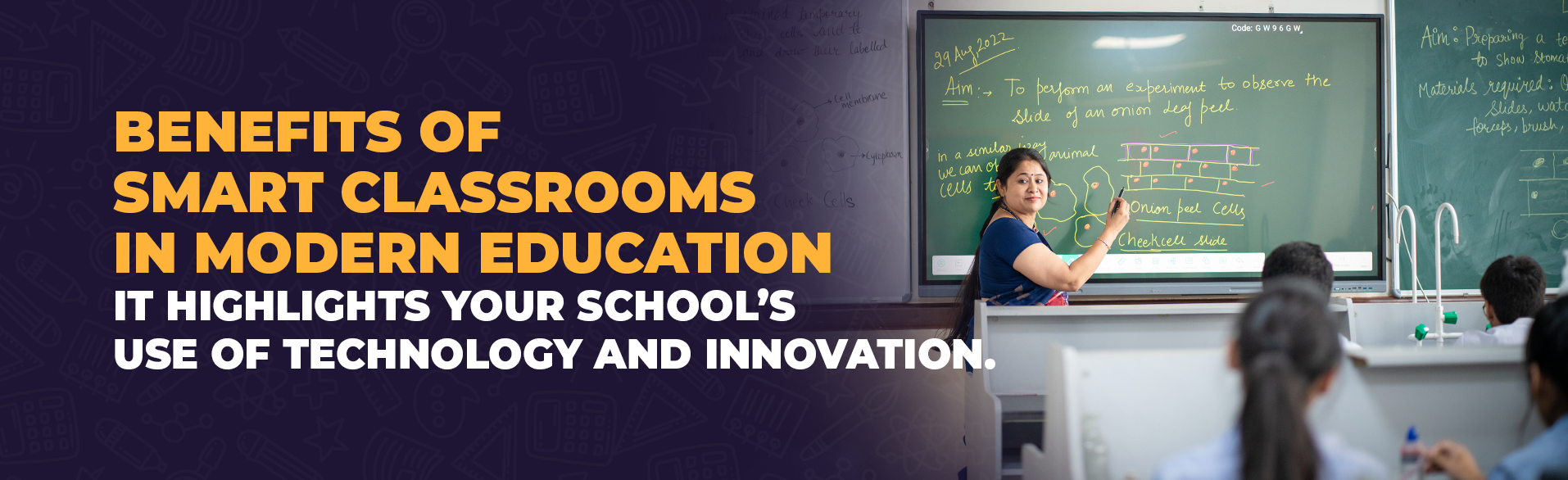
Walk into a school that bought hardware but skipped training and the picture changes. Digital board displaying the same notes a chalkboard carried. Tablets in a charging cart because nobody built a lesson around them. Technology present. Transformation absent. The difference is whether the teacher learned to teach differently, not just display differently.
What Digital Learning in Schools Actually Looks Like on a Tuesday Morning
Strip away the conference demos. Digital learning in schools on a Tuesday morning looks like a geography teacher pulling up a satellite overlay of the Ganges delta while explaining sedimentation. A Class IX student changing a ramp angle in a physics simulation and watching velocity shift live. The concept stops being imagined. It becomes visible.
The shift is not screens replacing notebooks. A lesson might use the board for twelve minutes during explanation and switch to notebooks for the rest. The best teachers treat it like a spotlight. On for a specific moment. Off so the room can focus on what comes next. Constant illumination blinds. Selective use reveals.
The Subjects Where the Screen Changed the Lesson
Science was the first subject to benefit and remains the strongest case. A biology teacher explaining mitosis from a textbook diagram competes against a three-minute animation showing the process in motion. The animation does not replace the teacher. It replaces the limitation of a static image trying to represent something dynamic.
Mathematics gained ground more recently. Geometry that required imagining a rotating 3D shape now appears on screen in real time. A student who could not visualise a cone's cross-section sees it sliced open and suddenly the formula makes physical sense. That bridge between visual and abstract justifies the installation.
- History: Lessons moved beyond memorising dates. Students explore period maps overlaid on modern geography and virtual walkthroughs of historical monuments. The subject becomes visual, spatial, and far easier to remember.
- Languages: Pronunciation tools provide instant feedback that one teacher cannot realistically offer to every student during a single class. Listening, speaking, and correcting pronunciation become continuous learning loops.
The thread across all four is the same. Smart boards did not change what gets taught. They changed which parts of the lesson a student can see, hear, or interact with instead of imagining from a static page. Where the concept is visual or dynamic, the screen earns its place. Where reflective, the notebook wins.
The teachers reporting the strongest results plan the lesson around the learning objective first and then decide whether the smart board supports that objective or distracts from it. Technology should always serve the lesson, never become the lesson.
Modern Education Technology That Survived Past the First Year
Every few years a new device or platform gets marketed as the future of schooling. Interactive whiteboards. Tablet-for-every-student programmes. VR headsets. The real test is not whether the technology impresses during a demonstration. It is whether teachers still use it eighteen months later when lesson planning becomes routine.
Modern education technology that survived the hype shares one characteristic. It removes friction instead of creating new problems.
- Projectors with annotation software: These became valuable because teachers could write, explain, and save notes without interrupting the flow of the lesson.
- Lesson recording features: Students absent from school can revisit the actual classroom explanation instead of relying only on copied notes.
- Tablet programmes with lengthy setup: When fifteen minutes disappear setting up devices during a forty-minute lesson, teachers naturally stop using the technology.
- VR headsets: Although impressive during demonstrations, calibration time and classroom logistics often make them impractical for everyday teaching.
The technologies that survive all share another advantage. They never force teachers to become technicians. A projector that connects with one click gets used daily. A platform requiring multiple passwords, software updates, and compatibility checks quickly gets ignored. Simplicity matters more than feature lists.
The Part Nobody Puts in the Brochure
A classroom built entirely around screens creates a different problem. Eye strain increases. Attention begins to fragment because every illuminated surface competes for focus. Six hours of classroom screen exposure followed by homework on another screen is not automatically better learning.
The classrooms producing the strongest results use technology selectively. The board comes on when visuals genuinely improve understanding, then switches off while students write, discuss, and reflect. That balance keeps attention fresh and learning active.
When the Board Goes Dark and the Room Still Works
The honest measure of a smart classroom is not what happens when technology works. It is what happens when it fails. A lesson that collapses because the projector stops working demonstrates dependency rather than effective integration.
The schools that continue benefiting from smart classrooms years after installation understand this well. Hardware was never the finish line. Teacher training continued. Lesson planning evolved. Collaboration between educators and technical teams became part of everyday school life. A projector in the hands of a well-trained teacher consistently delivers more value than a classroom full of advanced technology used without purpose.